


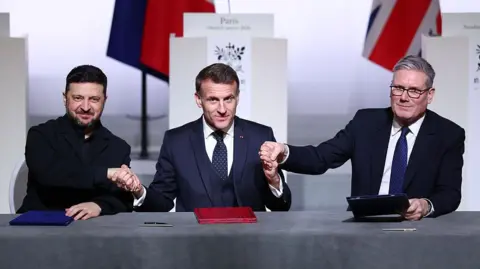
The British and French governments have formalized a memorandum of understanding concerning the deployment of armed personnel in the nation if a ceasefire be concluded with Moscow, the UK Prime Minister, Keir Starmer, has stated.
Subsequent to negotiations with Kyiv's partners in Paris, he indicated that the two nations would "create operational bases throughout Ukraine and erect fortified facilities for arms and military equipment" to prevent any future invasion.
The partner countries also proposed that the America would play the primary role in overseeing a truce.
Moscow has on multiple occasions warned that any foreign troops in Ukraine would be considered a "valid objective", but has so far not responded on this recent declaration.
Background and Ongoing Conflict
Moscow's leader Vladimir Putin initiated a major offensive of Ukraine in February 2022, and Russian forces currently controls roughly 20% of Ukraine's sovereign soil.
"This constitutes a crucial element of our pledge to support Ukraine for the long-term," stated the UK Prime Minister.
Top officials and high-ranking officials from the "Coalition of the Willing" participated in Tuesday's talks.
Speaking at a joint press conference, the Prime Minister further said: "It creates the pathway for the legal framework under which allied and coalition forces could work on the ground in Ukraine, securing Ukraine's airspace and waters, and rebuilding Ukraine's military for the time to come."
The UK prime minister also stated that London would take part in any Washington-directed monitoring of a possible ceasefire.
Protection Pledges and Negotiation Stances
Senior US negotiator Steve Witkoff stated that "long-term security guarantees and substantial economic promises are essential to a permanent resolution" in Ukraine – alluding to a major condition made by the Ukrainian government.
Witkoff indicated the coalition had "substantially agreed on" their work on establishing such guarantees "to ensure the people of Ukraine know that when this conflict ends, it ends for good."
Donald Trump's son-in-law, ex-President Donald Trump's special envoy, also was involved in the talks.
Separately, France's leader Emmanuel Macron stated that Ukraine's partners had made "significant headway" at the meeting.
He added that "comprehensive" safety pledges for Kyiv had been reached in the instance of a possible truce.
Ukrainian President Volodymyr Zelensky said that a "huge development" had been made in the talks, but cautioned that he would only consider efforts to be "enough" if they led to the cessation of the war.
Recently, the Ukrainian leader suggested a settlement was "90% ready". Finalizing the remaining 10% would "shape the future of the peace, the destiny of Ukraine and Europe".
Remaining Challenges
- Sovereign soil and security guarantees have been at the center of key disagreements for diplomats.
- The Russian President has consistently stated that Ukrainian troops must withdraw from all of Ukraine's eastern Donbas or Russia will occupy it, rejecting any compromise over how to conclude the war.
- The Ukrainian President has so far ruled out surrendering any territory, but has floated the idea that Ukraine could withdraw its forces to an mutually accepted point – but only if Russia follows suit.
Moscow presently controls approximately 75% of the Donetsk region and around 99% of the adjacent Luhansk region. The pair of oblasts form the heartland of Donbas.
The initial US-led 28-point proposal that was circulated to the media last year was viewed by Kyiv and its partners in Europe as being disproportionately favorable in Russia's favor.
This sparked weeks of intensive negotiations – with the involved parties trying to adjust the draft.
The previous month, Ukraine sent the US an updated 20-point plan – as well as distinct documents outlining possible security guarantees and provisions for Ukraine's recovery, he said.


