

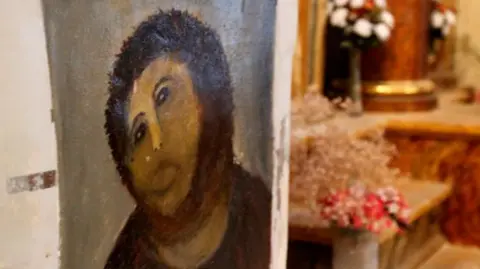
The Spanish parishioner who made international headlines for her poorly executed repair job on a cherished Jesus Christ fresco has died at the age 94.
The woman, a resident of the town of Borja in northeast Spain, rose to prominence 13 years ago after she attempted to repaint a 100-year-old painting titled Ecce Homo housed within her local church.
Giménez's handiwork quickly went viral and was dubbed "Potato Jesus", because the resulting likeness of Christ's head bearing a resemblance to a furry primate.
Official Confirmation and Homage
The 94-year-old's death was confirmed by Borja's mayor, Eduardo Arilla, in a social media post, where he described her as a "great enthusiast of painting from a very early age".
"Rest in peace Cecilia, your memory will live on with us," Arilla wrote.
Arilla further referenced Giménez's "now-legendary restoration of Ecce Homo" in the summer of 2012, which "due to the poor state of conservation it presented, Cecilia, with the best intentions, chose to apply new paint over the original".
The Artwork's History and the Fateful Act
The Ecce Homo ("Behold the Man" in Latin) painted by 19th century artist Elias Garcia Martinez had been held for more than a hundred years in the Sanctuary of Mercy Church near Zaragoza.
At the time, Giménez, then 81, explained that church members had "traditionally fixed everything here", and that she had received permission from the parish priest to do the work.
She also noted that anybody who entered the Church would have seen she was applying paint to the original image.
A Surprising Tourist Boom
The aftermath of the restoration spawned the "Ecce Mono" internet phenomenon and transformed the once quiet town of Borja quickly become a significant tourist destination.
The town, which had previously seen only 5,000 tourists per year, received more than 40,000 tourists by 2013, and managed to raise more than €50,000 for charity from the interest.
Currently, local authorities estimate that between 15,000 and 20,000 tourists travel to Borja every year to see the notorious portrait, which is now protected by a protective shield of glass.
Legacy and Local Support
After recovering from the initial backlash, with support from the townspeople and well-wishers globally, Giménez later hold an exhibition of her paintings showcasing twenty-eight of her personal paintings.
She was praised by the mayor for her kind-hearted nature and years of faithful service to the church.
In the end, what began as a well-intentioned but unsuccessful art repair forged an unlikely piece of pop culture and brought unprecedented tourist revenue to a small Spanish town.
